
HARTS is an ambitious student-led project taking part in the the international REXUS/BEXUS program, which was created by a partnership agreement between the German Aerospace Center DLR (Deutsche Zentrum fur Luft und Raumfahrt) and the Swedish National Space Agency (Rymdstyrelsen) in cooperation with the European Space Agency (ESA). The program allows students from ESA member states to test their experiment in the upper atmosphere, either by placing it on a stratospheric helium balloon the BEXUS program (Baloon Experiments for University Students) or by launching on a single-stage solid-fuel rocket – the REXUS program (Rocket Experiments for University Students) in which we are taking part of.
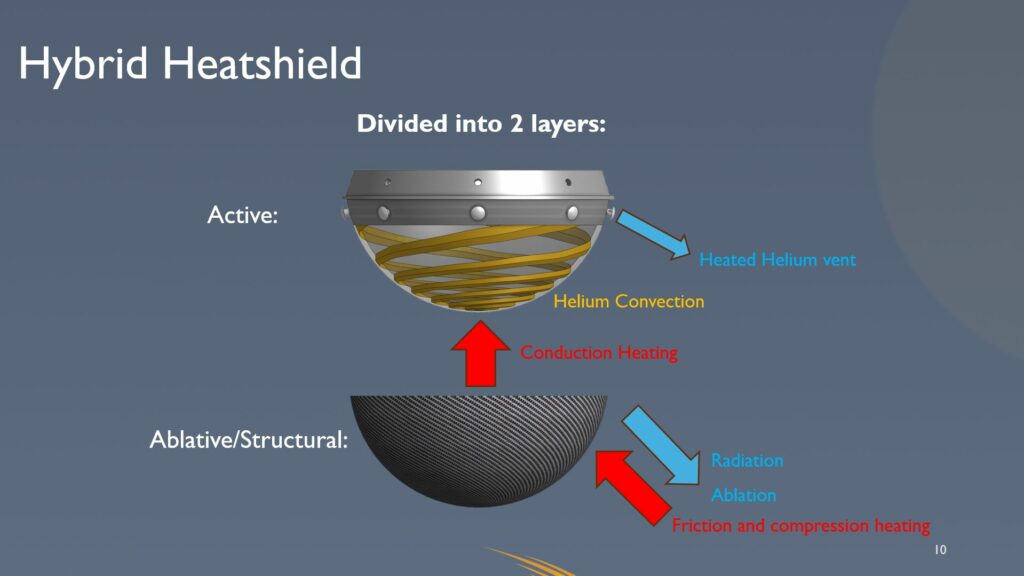
The hybrid shield concept was created as a successor to the active cooling concept and is based on the work of Active Heatshield Cooling Solutions, which won the ArianeGroup Prize in the ESA Student Aerospace Challenge 2024 for its complete assessment of the issue and relevance, as there is still no reliable solution for safe descent into the atmosphere. This system had several drawbacks, such as high fuel consumption and greater weight than current thermal protection systems. Based on feedback from Ariane researchers working on carbon composite heat shields, the concept was transformed into the HARTS system. HARTS aims to compensate for the disadvantages of composite heat shields, which are a newly used technology due to their structural strength and the possibility of relamination or replacement of composite sheets, making them reusable. Their main disadvantage is the lack of cooling through ablation and their conductivity, which can dangerously heat up the internal components of spacecraft. Adding active cooling compensates these disadvantages by heat dissipation with excess helium, which is used to pressurize fuel tanks. The hybrid shield thus provides reliable protection against extreme temperatures and allows for the regulation of temperature at heat flux peaks.
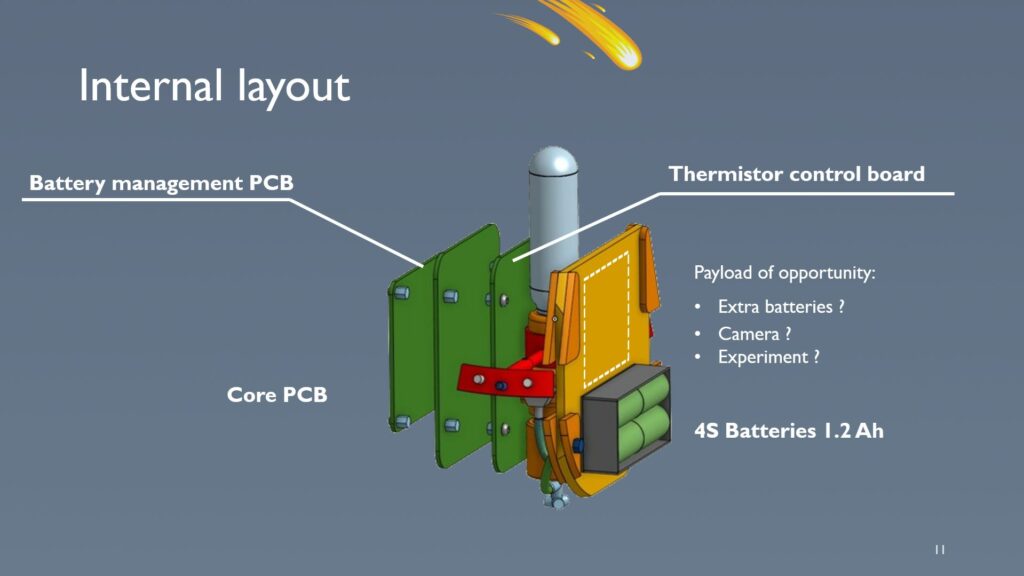
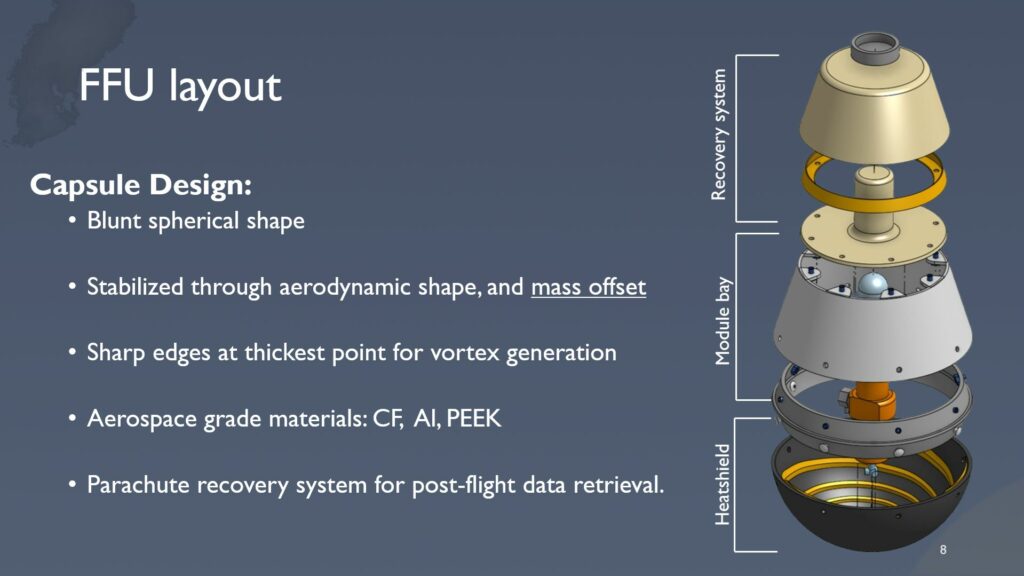
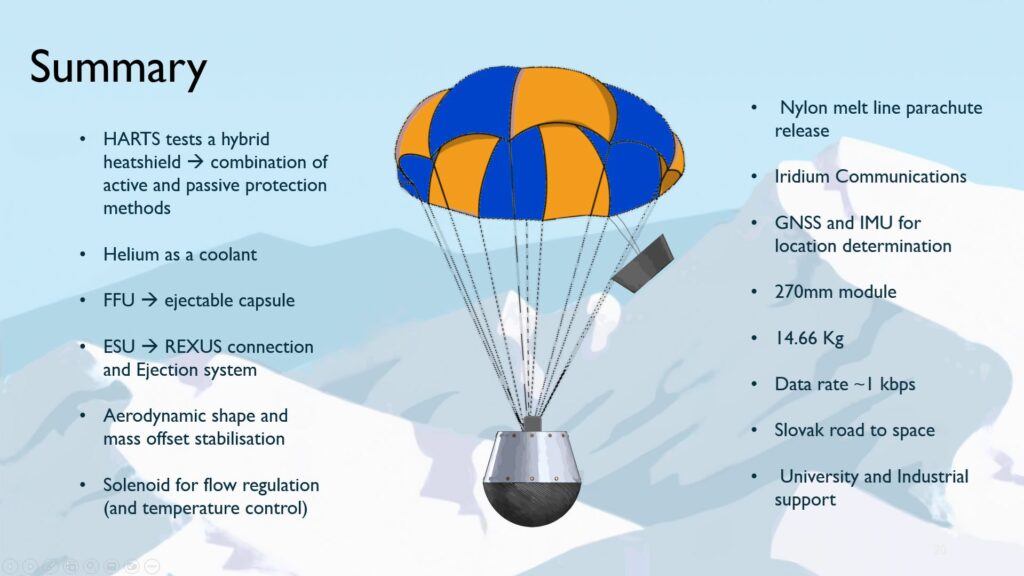
The heat shield will be launched on an ejectable experimental capsule on a REXUS sounding rocket to an altitude of ~85 km in March 2026. The capsule separates from the rocket at the highest point of the trajectory and begins to transmit telemetry and thermal data about its state. During the descent through the atmosphere, sensors will monitor the temperature of the shield, and if this temperature reaches a critical value, helium will be automatically released into the pipes integrated in the ablative shield, which will dissipate excess heat. At an altitude of 4 km, the parachute opens, which will ensure the safe return of the capsule. This experiment will provide important insights into function under realistic atmospheric descent conditions and allow us to improve on the technology of hybrid heatshields.